Home › Training › Presenting & Storytelling
Training · Presenting & Storytelling

Presenting is more than showing slides.
It is taking people into how you think.

Create clarity, spark interest, convince people. We train the structure, the story, and the delivery — voice, posture, presence — with trainers whose roots are in radio and TV journalism. And then we hand out dice, because nobody gets better at this sitting down.

22×
Our brain remembers stories up to 22 times better than plain facts
Story, not slides
Which is why every pitch and every presentation should be built as a story
Voice & body
We train the delivery too: voice, body language, presence in the room
Radio & TV
Professional trainers — our roots are in radio and TV journalism
The base structure

Orientation for the audience, safety for you.

A good presentation follows a clear arc. It is not only about the content: how do I meet the audience where they are, how do I hold attention, and how do I stay in their memory? Pick a part.

Part 01 · Opening

Meet the audience where they are.

A good opening creates curiosity and shows why it is worth listening. It picks people up at the point they are actually standing at, not at the point you have already reached.

Tip: Combine opening, link to the topic and a preview of the structure in one to two minutes.
Examples of openings
A provocative question: “What if we were not allowed to write any emails from tomorrow?”
A personal scene: “When I was first allowed to lead a project, I knew one thing above all — what I did not know.”
A fitting quote: “Life can only be understood backwards, but it must be lived forwards.” (Kierkegaard)
Expert to layperson

We often know so much that we forget how little others know.

The key to being understood is leaving the expert role and stepping into the role of someone explaining: friendly, clear, structured, vivid. Being understandable does not mean saying less. It means saying it so that it lands.

Test your explanation on someone who has nothing to do with the topic.
Adapt the language
✕ “We are integrating an ERP system.”
✓ “We are introducing one central piece of software that connects every area, from purchasing to production.”
Use vivid language
✕ A precise definition of the process landscape.
✓ “Think of it as a navigation system for our processes — it shows us where we are stuck.”
Everyday analogies
✕ “Our spare-parts logistics has a reorder-point problem.”
✓ “You know it from the supermarket: once the shelf is empty, it is too late to order.”
Our own game

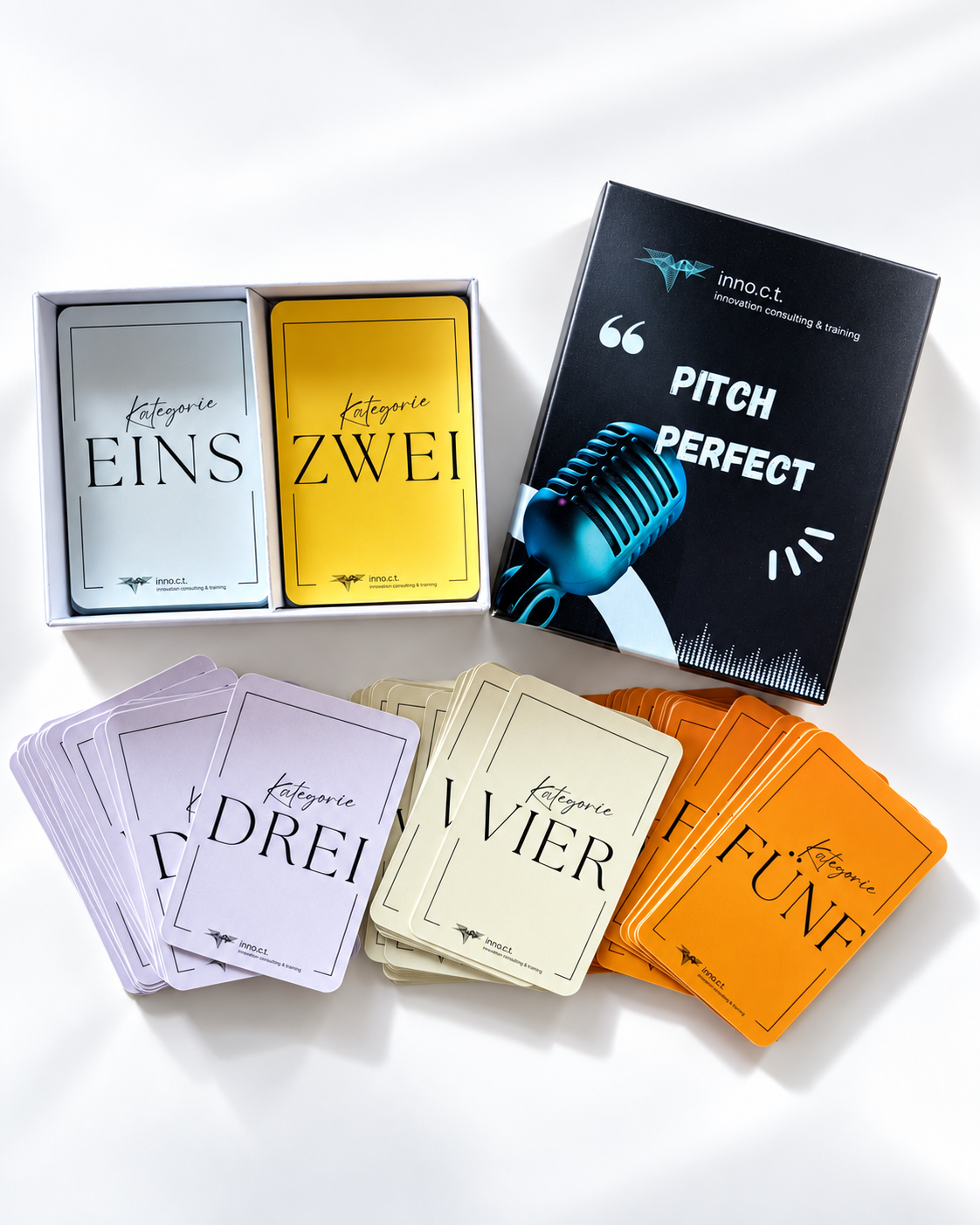
Pitch Perfect

Roll the dice, get a category, get a task — and present. Five categories of cards, each with a different kind of challenge, from the impromptu first sentence to the story you did not see coming.

Nobody talks their way out of this one. Everyone presents, everyone gets feedback, and the room gets funnier and braver with every round.

Five card categories One dice Everybody presents Immediate feedback

We keep the cards for the room. The game only works when there is an audience, a clock and somebody standing up.

Pitch Perfect: the box and the five card categories

Bring the presentation nobody wants to give.

Tell us what your people need to present and where confidence or clarity breaks down. Available as an open training, an in-house day on your own topics, or a module inside a leadership or talent programme.